



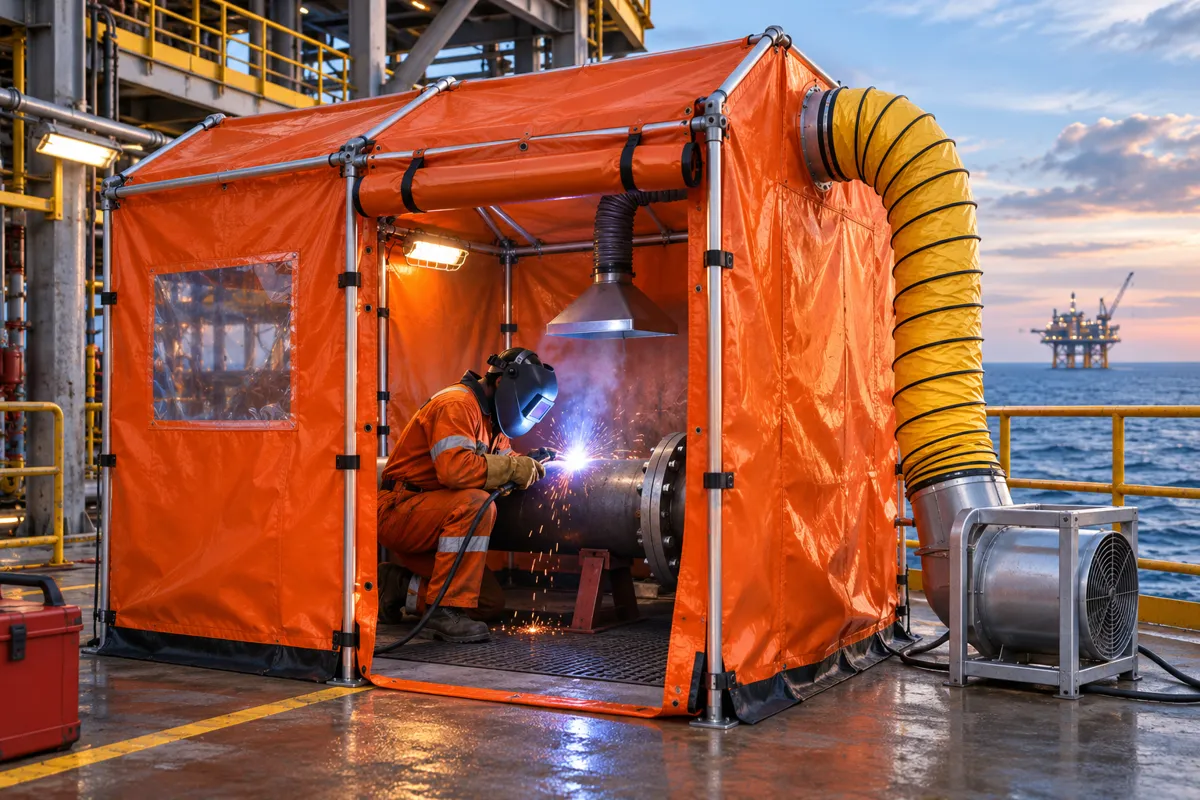
A welding habitat is a temporary enclosure that lets you weld, cut or grind in a hazardous area without a plant shutdown. A pressurised welding habitat goes one step further: it holds the inside of the enclosure at a slightly higher pressure than the surroundings, so flammable gas cannot reach the hot work.
Why Use a Welding Habitat?
Hot work in or near a classified area is one of the highest-risk jobs on an oil and gas site. Shutting down production to make it safe is expensive. A welding habitat creates a controlled working space around the job, so the repair can go ahead while the surrounding plant stays in service, where the site procedure allows it.
How a Pressurised Welding Habitat Works
- Enclosure. A fire-resistant shell is built around the work area, sealing it from the hazardous atmosphere outside.
- Clean air supply. Air from a safe, non-hazardous location is fed into the habitat to keep it under slight positive pressure.
- Pressure monitoring. A sensor confirms the habitat stays above the outside pressure. A drop raises an alarm.
- Gas detection. Detectors check the air inside and outside. A gas alarm stops the hot work and the supply of power to welding equipment.
- Fume extraction. Welding fume is removed so the crew can work in clean air.
Pressurised vs Non-Pressurised Habitats
| Point | Pressurised habitat | Non-pressurised or vented habitat |
|---|---|---|
| Principle | Positive pressure keeps gas out | Relies on sealing and gas monitoring |
| Typical use | Hot work in zoned areas with a gas risk | Lower-risk areas or screening from weather and sparks |
| Safeguards | Pressure monitor, gas detection, alarms | Gas detection, fire watch |
Offshore Welding Habitat Considerations
- Space and weight. Platform decks are tight. Habitats are usually delivered as modular kits that are carried to site and assembled.
- Services. Plan the clean air supply, power, lighting and fume extraction before mobilisation.
- Wind and weather. The shell must resist offshore wind and rain while the job is in progress.
- Permits and competence. Installation, gas testing and the hot work permit follow your site procedure. Use trained personnel.
Welding Habitats from Daly Middle East
Daly Middle East supplies welding habitat systems in the UAE and GCC, including the Cairn Cocoon welding habitat from Cairn Safety Technology. For confined-space ventilation and related safety equipment, see our confined space safety page. Zone drawings decide what can be installed, so read our ATEX zones guide first, then contact our team with your site details and we will help you scope a suitable system.
Welding Habitat: Frequently Asked Questions
What is a welding habitat?
A welding habitat is a temporary enclosure built around a hot work area so welding, cutting or grinding can be done safely inside a hazardous or classified area without shutting the plant down.
What is a pressurised welding habitat?
It is a welding habitat kept at a slightly higher pressure than the surrounding area using a clean air supply, so flammable gas cannot enter. Gas detectors and pressure monitoring back this up and raise an alarm or trigger shutdown if conditions change.
Do welding habitats still need a hot work permit?
Yes. A habitat is a control measure, not a replacement for the site permit-to-work. The permit, gas testing, fire watch and emergency plan all still apply.
Where are welding habitats used offshore?
Typical uses are repairs and tie-ins on live platforms, FPSOs, process modules, pipework and vessels where shutting down production for hot work would be costly or unsafe.
How do I choose a welding habitat?
Match the habitat to the zone and gas on site, the size of the work area, the access and services you need inside, the gas detection and pressure monitoring required by your procedure, and how quickly it must be installed and removed.