



The H&B RTD sensor models cover 19 distinct assembly styles built around the same platinum sensing element — from replaceable inserts that drop into an existing thermowell to magnetic probes you can reposition by hand. Daly Middle East stocks the full range for UAE and GCC projects, manufactured to IEC 60751 in Pt100 and Pt1000 formats, in 2, 3 or 4-wire configurations, with accuracy classes down to 1/10 DIN. This guide covers every model grouped by how it mounts, so you can match the assembly to your process connection before requesting a quotation.
How the H&B RTD Sensor Models Are Organised
Every RTD in this range works on the same principle: a platinum element changes resistance predictably with temperature, and the instrument converts that resistance back into a reading. What separates the H&B RTD sensor models from one another is not the sensing method but the mechanical package around it — how the probe reaches the process, how it is secured, and how the signal leaves the sensor.
H&B splits the range into four families, and the choice between them is usually decided by the installation rather than the measurement itself:
- Inserts — a spring-loaded probe designed to sit inside a thermowell you already have, so the element can be replaced without breaking into the process.
- Housed assemblies — a probe fitted with an industrial connection head, giving you a terminal chamber for wiring and room for a 4–20 mA transmitter.
- Cable assemblies — a probe terminated directly into cable and flying leads, for compact or awkward locations where a connection head will not fit.
- Thermowell assemblies — the complete package, supplied with the sensor already matched to a threaded, flanged, weld-in or hygienic well.
If you need the fundamentals first, our introduction to H&B RTD sensors explains where resistance thermometry fits against thermocouples.
H&B RTD Sensor Models at a Glance
The table below lists all 19 H&B RTD sensor models, plus two assemblies with integrated electronics — scroll to compare mounting style and typical duty before reading the detail.
| Model | Family | Mounting / Connection | Typical Duty |
|---|---|---|---|
| RTD101 | Insert | DIN plate, spring loaded | Replaceable element inside a thermowell |
| RTD160 | Insert | Threaded, 12 mm spring loading | Insert with its own process thread |
| RTD301 | Housing | Connection head | Compression fitting or duct plate |
| RTD310 | Housing | Connection head + thread | Direct threaded process entry |
| RTD320 | Housing | Integral extension + thread | Lagged or insulated pipework |
| RTD340 | Housing | Spring loaded, 1/2″ BSPP head | Mates to extensions or thermowells |
| RTD401 | Housing | Spring loaded + extension | Hazardous-area duties, Zones 0–22 |
| RTD601 | Housing | Flat-surface mount, guard tube | Air and duct temperature |
| RTD701 | Housing | Pipe clamp, surface mounted | Non-invasive pipe measurement |
| RTD800 | Housing | Extension + flange | Flanged vessel and line connections |
| RTD501 | Cable | Cable + flying leads | General immersion, compact spaces |
| RTD510 | Cable | Plain pot + armoured conduit | Heavy-duty cable protection |
| RTD520 | Cable | Process thread + cable | Threaded entry without a head |
| RTD575 | Cable | Nylon handle, penetration probe | Portable and spot checks |
| RTD580 | Cable | Oil-tight transition barrier | Bearing and oil-film monitoring |
| RTD720 | Surface | Strap-on, hose clip banding | Retrofit onto pipes and tubes |
| RTD725 | Surface | Weld-on, 316 stainless steel | Permanent surface measurement |
| RTD730 | Surface | Bolt-on, 6.5 mm bolt hole | Bolted plant and equipment |
| RTD740 | Surface | Magnetic, ferrous metals | Temporary or moveable points |
| RTD390 | Electronics | Connection head + LCD display | Local indication and data logging |
| HBS6000 | Electronics | DIN 43650 connector + thread | Integrated 4–20 mA transmitter |
RTD Inserts: Replaceable Sensing Elements
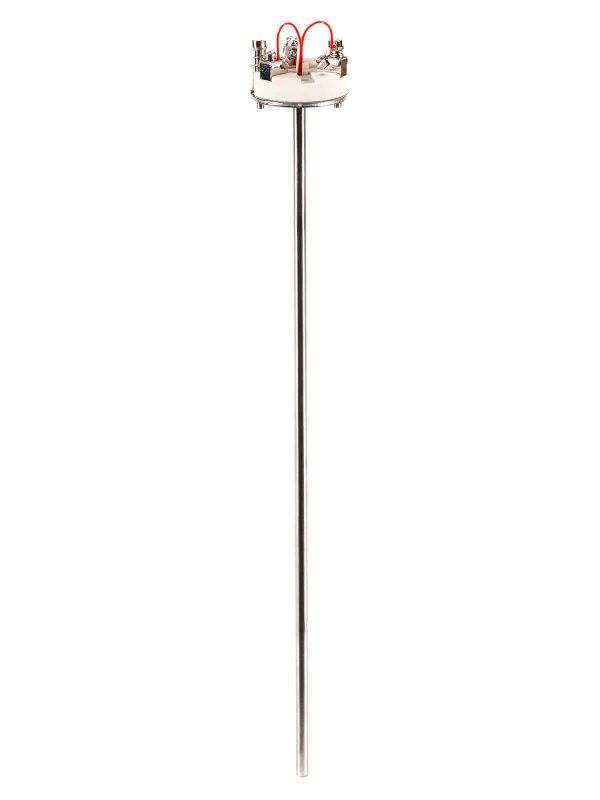
Two of the H&B RTD sensor models are inserts, and these never touch the process directly. They sit inside a thermowell, held against the bottom of the well by a spring so the tip keeps contact as the assembly expands and contracts. The advantage is maintenance: the element can be withdrawn and swapped while the well stays in the line and the process stays running.
RTD101: Spring Loaded Sensor with DIN Plate
The RTD101 is the standard DIN-plate insert, sized to drop into a connection head already fitted to a thermowell.
- Pt100 or Pt1000 in 2, 3 or 4-wire configurations
- Accuracy classes from 1/10 DIN through 1/5 DIN, 1/3 DIN and Class A to Class B
- Temperature range −196 °C to +650 °C
- Terminated with a ceramic terminal block, a 4–20 mA transmitter, or 150 mm tails
RTD160: Spring Loaded Sensor with Thread
The RTD160 adds a process thread to the insert format, with 12 mm of spring loading and a process-style connection head.
- Process and head threads in BSPP, BSPT, NPT or Metric
- Pt100 or Pt1000, 2, 3 or 4-wire, across the full accuracy class range
- Temperature range −196 °C to +650 °C
- 12 mm spring loading for consistent tip contact inside the well
Housed RTDs with Connection Heads
Eight of the H&B RTD sensor models pair the probe with an industrial connection head in aluminium, stainless steel or plastic, with M20 x 1.5 cable entry. The head gives you a sealed terminal chamber and, where required, space to mount a transmitter or an indicator at the measurement point rather than back in the panel.
RTD301: Sensor with Connection Head
The RTD301 is the baseline housed assembly, secured with a compression fitting or duct plate so insertion depth can be set on site.
- Simplex, duplex or triplex Pt100 or Pt1000 elements
- Ceramic terminal block, 4–20 mA transmitter or tails; loop or battery powered
- Hazardous area options: ATEX, IECEx and UKEX in Exia or Exd
RTD310: Sensor with Connection Head & Thread
The RTD310 replaces the compression fitting with a fixed process thread — the usual choice where insertion depth is set by the specification rather than adjusted in the field.
- BSPP, BSPT, NPT or Metric process threads
- Aluminium, stainless steel or plastic heads with M20 x 1.5 entry
- Certified for Zones 0, 1, 2, 20, 21 and 22; −196 °C to +650 °C
RTD320: Sensor with Integral Extension & Thread
The RTD320 lifts the head away from the process on an integral extension — useful on lagged pipework, or where the head would otherwise sit in a hot zone.
- Extension keeps head electronics clear of process heat and insulation
- Full range of thread connections, head materials and terminations
- Hazardous area approvals available across the standard zones
RTD340: Spring Loaded Sensor with Connection Head
The RTD340 carries a 1/2″ BSPP head thread for connection to extension pieces or thermowells, combining spring loading with a full head assembly.
- Accuracy classes 1/10 DIN, 1/5 DIN, 1/3 DIN, Class A or Class B
- ATEX, IECEx and UKEX Exia approval available
- Temperature range −196 °C to +650 °C
RTD401: Spring Loaded Sensor with Extension
The RTD401 is the most widely specified hazardous-area assembly in the range, approved for Zones 0, 1, 2, 20, 21 and 22 with duplex configurations available for redundant measurement.
- Spring loaded with extension for thermowell mounting
- Duplex option for redundancy or separate control and monitoring signals
- Loop or battery powered indicator options
RTD601: Air Sensor
The RTD601 is built for air rather than liquid — a stainless steel protective guard tube on a flat mounting surface, for duct and ambient measurement.
- Duplex Pt100 with stainless steel guard tube
- Flat-surface mounting for ducts, plenums and enclosures
- Hazardous area approvals available
RTD701: Pipe Clamp Sensor
The RTD701 measures pipe surface temperature without penetrating the line — the option where the process cannot be broken into, or where a thermowell is not justified.
- Surface mounted with a full connection head
- Ceramic terminal block or 4–20 mA transmitter termination
- Hazardous area approvals; −196 °C to +650 °C
RTD800: Sensor with Extension & Flange
The RTD800 is the flanged assembly, supplied in a range of flange sizes and pressure ratings for vessels and larger process lines.
- Multiple flange sizes and ratings to suit the line specification
- Extension between flange and head for thermal separation
- Hazardous area approvals across the standard zones
Cable-Terminated RTDs
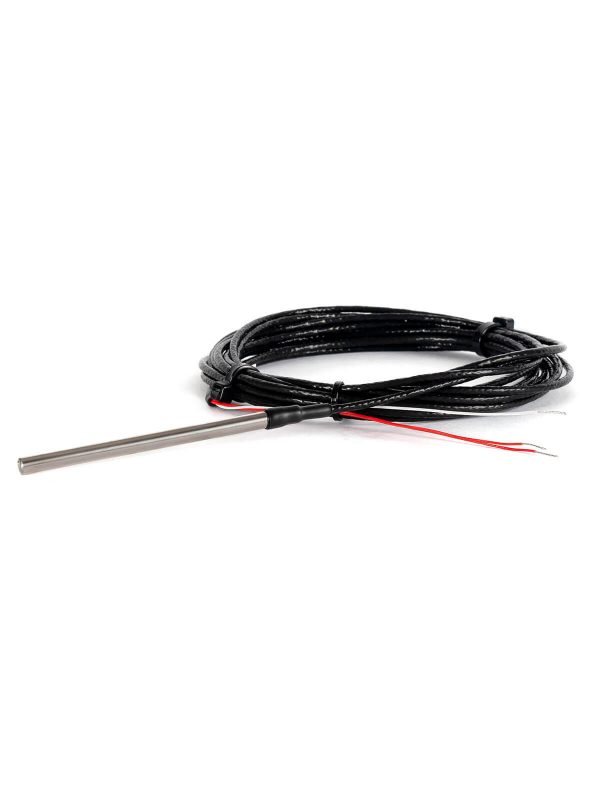
Five of the H&B RTD sensor models skip the connection head entirely and run the signal straight out on cable. All are offered with PTFE, PFA or fibreglass cable, chosen against the ambient temperature and chemical exposure at the cable route rather than at the probe tip.
RTD501: Sensor with Cable & Flying Leads
The RTD501 is the general-purpose cable assembly, secured with a compression fitting or duct plate and available in simplex, duplex or triplex builds.
RTD510: Plain Pot, Armoured Conduit & Flying Leads
The RTD510 is the heavy-duty version, adding flexible metallic armoured conduit to protect the cable where it is exposed to mechanical damage.
RTD520: Thread, Cable & Flying Leads
The RTD520 adds a BSPP, BSPT, NPT or Metric process thread to the cable format, sealing into the process without needing a compression fitting.
RTD575: Handle Sensor with Cable & Flying Leads
The RTD575 is the portable model — a stainless steel penetration probe on a nylon handle, for spot checks and sampling rather than fixed installation.
RTD580: Oil-Tight Bearing Sensor
The RTD580 monitors bearing temperature and oil-film condition on rotating equipment. Its transition barrier prevents oil migrating along the cable, and each unit ships with a pressure test certificate verifying the leak-proof design.
Surface-Mounted RTDs
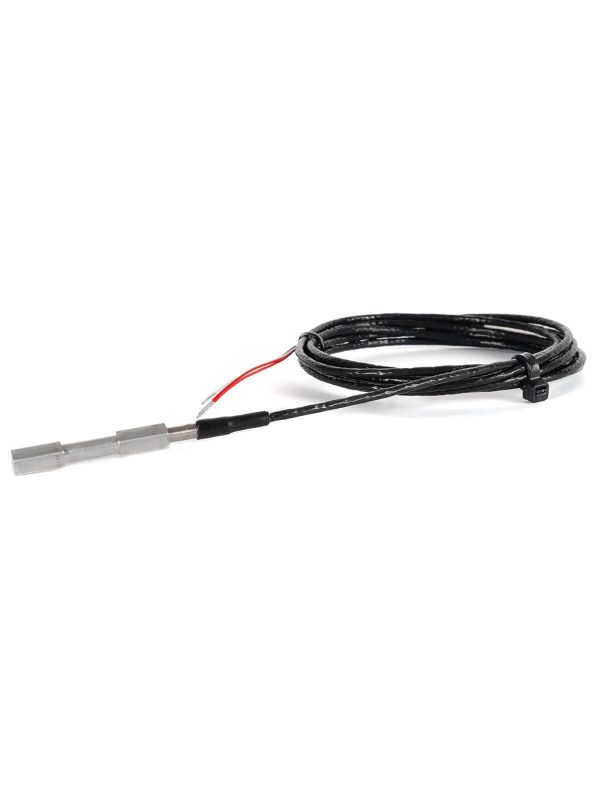
Where the process cannot be penetrated at all, four of the H&B RTD sensor models measure surface temperature instead. They differ only in how they attach — all four share the same Pt100 or Pt1000 element options, accuracy classes and −196 °C to +650 °C range.
- RTD720 Strap-On — secured with jubilee hose clip banding and a screw box; the quickest retrofit onto an existing pipe or tube.
- RTD725 Weld-On — 316 stainless steel, welded directly to the surface for a permanent, high-integrity thermal path.
- RTD730 Bolt-On — a 6.5 mm bolt hole lets the sensor mount to existing bolted plant without welding.
- RTD740 Magnetic — attaches to ferrous metal by magnet, for temporary points and commissioning surveys.
RTD Assemblies Supplied with Thermowells
Where the sensor cannot be exposed to process pressure, flow velocity or chemical attack, most of the H&B RTD sensor models can be supplied already matched to a thermowell. Daly Middle East stocks 16 such assemblies, split by how the well is manufactured and how it connects:
- Solid drilled — machined from bar stock for higher pressure and velocity duties.
- Fabricated — welded construction, a cost-effective route for less demanding services.
- Threaded, flanged and weld-in — including stepped flanged and coated variants for corrosive media.
- Hygienic — Tri-Clamp, DIN 11851, SMS, RJT and IDF/ISS connections for food, beverage, dairy and pharmaceutical process lines.
Our guide to H&B thermowells covers the selection logic in more depth, and the full range sits in the thermowells category.
RTD Models with Integrated Electronics
Two of the H&B RTD sensor models go beyond a bare resistance output and condition the signal at the sensor itself.
RTD390: Sensor with Digital Indicator
The RTD390 puts a six-digit battery-powered LCD display at the measurement point, with dual relay trips and onboard data logging for up to 5,000 points. It uses a simplex 3-wire Pt100 element in a stainless steel case that can be oriented to suit the installation, and the display supports custom messages.
HBS6000: Temperature Transmitter with RTD Sensor & Thread
The HBS6000 (RTD6K1) combines a 316 stainless steel Pt100 probe with an integrated 4–20 mA transmitter and a DIN 43650 connector for simple wiring. Range, units and error detection are programmed over PC using the HBSUSB1 kit. For loose transmitters to pair with any sensor above, see the temperature transmitters category.
Shared Specifications Across the H&B RTD Sensor Models
Most selection decisions come down to mechanics, because the electrical options are common to nearly every model in the range. Across the H&B RTD sensor models you can specify:
- Element — Pt100 or Pt1000, to IEC 60751
- Wiring — 2, 3 or 4-wire; simplex, duplex or triplex
- Accuracy class — 1/10 DIN, 1/5 DIN, 1/3 DIN, Class A or Class B
- Temperature range — −196 °C to +650 °C on the majority of assemblies
- Process threads — BSPP, BSPT, NPT or Metric
- Cable — PTFE, PFA or fibreglass
- Head materials — aluminium, stainless steel or plastic, M20 x 1.5 entry
- Certification — ATEX, IECEx and UKEX in Exia or Exd for Zones 0, 1, 2, 20, 21 and 22
How to Choose Between the H&B RTD Sensor Models
Narrow the H&B RTD sensor models against the constraint that actually drives the decision on your site — usually the process connection or the area classification rather than the accuracy class itself.
- Existing thermowell already installed — RTD101 or RTD160 inserts, so the element is replaceable without a shutdown.
- New pressurised or corrosive service — an RTD supplied with a solid drilled thermowell, sized to the line.
- Classified hazardous area — RTD401, RTD310 or RTD301 with the ATEX/IECEx/UKEX approval that matches your zone.
- Cannot break into the pipe — RTD701 pipe clamp, or RTD720/RTD725/RTD730 surface sensors.
- Rotating equipment and bearings — RTD580, with its oil-tight barrier and pressure test certificate.
- Hygienic process lines — a Tri-Clamp, DIN 11851, SMS, RJT or IDF/ISS thermowell assembly.
- Local reading needed at the sensor — RTD390 for display and logging, or HBS6000 for a 4–20 mA output.
- Portable spot checks — RTD575 handle sensor.
- Long cable runs — specify Pt1000 and 3 or 4-wire to limit lead resistance error.
Buying H&B RTD Sensor Models in the UAE and GCC
Daly Middle East supplies H&B Sensors temperature and level instruments across the UAE and the wider GCC, serving oil and gas, petrochemical, power generation, water and wastewater, food and beverage, pharmaceutical and marine projects. All of the H&B RTD sensor models in this guide can be quoted as complete assemblies with connection heads, cables, process fittings, thermowells, transmitters and certification documentation.
Browse the full RTD sensors category, or contact the Daly Middle East team with your temperature range, process connection, insertion length, material preference and any hazardous-area requirement. Sharing a datasheet or tag list gets you a configured selection faster than a model number alone, and the team can cross-reference the H&B RTD sensor models against an existing tag schedule where you are replacing another manufacturer.
H&B RTD Sensor Models: FAQ
Which H&B RTD sensor models are approved for hazardous areas?
The housed assemblies carry the approvals — RTD301, RTD310, RTD320, RTD340, RTD401, RTD601, RTD701 and RTD800 are available with ATEX, IECEx and UKEX certification in Exia or Exd, covering Zones 0, 1, 2, 20, 21 and 22. Confirm your area classification before selecting, as the cable and surface-mounted models are supplied without hazardous-area approval by default.
Should I specify Pt100 or Pt1000?
Every one of the H&B RTD sensor models is offered in both. Pt100 is the industrial default and matches most control system inputs. Pt1000 gives ten times the resistance, which reduces the relative effect of lead resistance — worth specifying on long cable runs or where only a 2-wire connection is possible.
What is the difference between an insert and a complete assembly?
An insert (RTD101 or RTD160) is the sensing element alone, designed to sit inside a thermowell that is already installed. A complete assembly ships as sensor and thermowell matched together. Inserts are the better choice for maintenance, because the element can be replaced without breaking containment.
Which accuracy class do I need?
Class B suits general monitoring, Class A and 1/3 DIN cover most process control, and 1/5 DIN or 1/10 DIN are specified where custody transfer, product quality or safety cases demand the tightest tolerance. Every one of the H&B RTD sensor models is available across all five classes.
Can I measure pipe temperature without shutting down the line?
Yes. The RTD701 pipe clamp and the RTD720, RTD725, RTD730 and RTD740 surface sensors all read through the pipe wall. Surface measurement reads slightly lower than the true process temperature, so insulate over the sensor where accuracy matters.
The H&B RTD sensor models share one platinum sensing technology across 19 mechanical formats, which means the specification work is mostly about the installation — the process connection, the insertion length, the area classification and how the sensor will be maintained. Get those right and the measurement performance follows.
Related Reading
- H&B RTD Sensors for Accurate Industrial Temperature Measurement
- H&B Thermocouples for High-Temperature Process Measurement
- H&B Thermowells for Safe Temperature Sensor Protection
Manufacturer reference: H&B Sensors RTD product range.